



Phenyltrichlorosilane
Zouping Jinxing Chemical Co., Ltd. is one of the leading manufacturers and suppliers of phenyltrichlorosilane in China. If you're going to wholesale bulk phenyltrichlorosilane made in China, welcome to get free sample from our factory. All customized products are with high quality and low price.
Basic physical properties
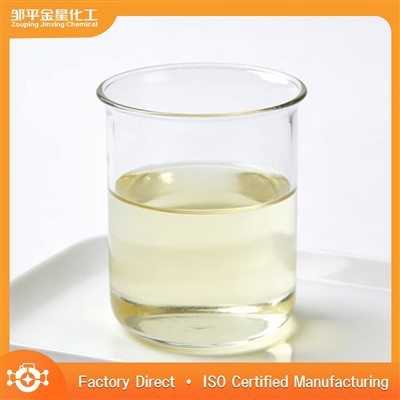
Appearance: Phenyltrichlorosilane is a colorless to pale yellow, transparent liquid with a pungent odor.
Boiling point: 201°C (atmospheric pressure)
Density: Approx. 1.32 g/cm³ (25°C)
Flash point: 88–91°C (closed cup)
Solubility: Soluble in organic solvents such as benzene, diethyl ether, and chloroform; reacts violently with water
Primary Uses
As a core raw material for phenyl silicone resins and phenyl silicone oils, it is widely used in:
Coatings and inks: Enhancing coating weather resistance, adhesion, and gloss
Silane coupling agents: Improving interfacial bonding between organic materials and inorganic fillers
Electronics and semiconductors: Phenyltrichlorosilane can be used to prepare silicon-based thin films and specialty coatings.
Organic synthesis: Serving as a phenyl-silylation reagent to introduce silicon atoms or phenyl structures
Three mainstream synthetic routes
Industrialized methods include the direct method, the thermal condensation method, and the Grignard method, each with its own specific characteristics.
Direct method (the mainstream international approach and the route adopted by major domestic enterprises like Xinyaqiang): Chlorobenzene and silicon powder react at 400–600°C using a copper or silver catalyst to produce crude monomers; phenyltrichlorosilane and diphenyldichlorosilane are then separated via fractional distillation. Its advantage lies in the ability to flexibly adjust the ratio of the two products, while its drawback is the generation of toxic dichlorobiphenyl as a byproduct, which requires removal via an absorption process.
Thermal condensation method: This process uses trichlorosilane and chlorobenzene as raw materials for a high-temperature (approx. 600°C) gas-phase reaction. It requires no catalysts or solvents and utilizes simple equipment; however, it is prone to carbon deposition that can clog pipelines, and it is limited to producing only phenyltrichlorosilane.
Grignard method: Chlorobenzene reacts with magnesium turnings-initiated by bromoethane-to form a phenyl Grignard reagent, which then reacts with silicon tetrachloride. This method offers high reaction selectivity, minimal byproducts, and high yields; however, the extensive use of solvents and the high reactivity of the Grignard reagent impose stringent requirements on equipment and safety management.
FAQ
Q: Key Points for Handling and Storage
A:Fully enclosed system + dry room (RH < 30%) + explosion-proof ventilation; material transfer performed in a dry glovebox or under a nitrogen blanket;
PPE: Acid-resistant butyl or neoprene gloves, acid-resistant goggles and face shield, chemical-resistant suit (acid/alkali resistant), organic vapor and acid gas filter cartridges (SCBA required for high concentrations); bare-hand contact is strictly prohibited;
Storage: Store in original drums under nitrogen seal in a cool (≤30°C) and dry warehouse; keep strictly isolated from strong bases, water, alcohols, amines, oxidizing agents, and foodstuffs; use contents promptly after opening and keep desiccant at the drum opening;
Spills: Absorb with dry sand, vermiculite, or diatomaceous earth (do not flush with water, as this causes violent HCl release); collect in plastic-lined containers and dispose of via qualified incineration as chlorine- and silicon-containing hazardous waste (with tail-gas HCl scrubbing);
Firefighting: Use dry powder, CO₂, alcohol-resistant foam, or sand/soil; do not use direct water streams (causes splashing and HCl release); firefighters must wear SCBA.
Q: Toxicity and Occupational Health
A:Moderate acute toxicity: Rat oral LD₅₀ 2390 mg/kg, rabbit dermal 890 mg/kg, mouse inhalation LC₅₀ 330 mg/m³/2h;
Primary hazard is corrosivity rather than systemic toxicity:
Skin contact → Severe burns (Skin Corr. 1A), H314;
Eye contact → Irreversible eye damage (Eye Dam. 1);
Inhalation of vapor/hydrolysis to HCl → Respiratory tract corrosion, pulmonary edema (EUH071 "Corrosive to the respiratory tract");
Ingestion → Burns to the mouth and digestive tract;
GHS labeling: Danger, H330 (Fatal if inhaled) / H312 (Harmful in contact with skin) / H314 (Causes severe skin burns) / H227 (Combustible liquid) / H290 (May be corrosive to metals);
No IARC carcinogenicity classification, but long-term exposure to HCl vapor causes dental erosion and chronic bronchitis.
Q: chemical properties
A: Undergoes violent hydrolysis upon contact with water or moist air: C₆H₅SiCl₃ + 3H₂O → C₆H₅Si(OH)₃ + 3HCl↑; reaction is exothermic, releases white fumes (HCl), and forms a phenylsiloxane gel; Reacts vigorously with alcohols, amines, and bases, releasing HCl; Decomposes at high temperatures to yield HCl, SiOₓ smoke/dust, and aromatic hydrocarbon fragments; Corrosive to aluminum, zinc, and iron (due to the action of HCl).
Hot Tags: phenyltrichlorosilane, China phenyltrichlorosilane manufacturers, suppliers, factories, 2 3 dimethylene, acid hydrolysis of butyl acetate, Anhydrous Ethanol, anhydrous ethanol alcohol, aspirin solubility in dichloromethane, tetrahydrofuran aldrich
Previous
Sulfur HexafluorideYou Might Also Like




Send Inquiry