



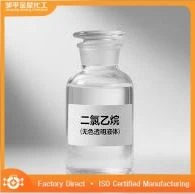
Dichloroethane
Zouping Jinxing Chemical Co., Ltd. is one of the leading manufacturers and suppliers of dichloroethane in China. If you're going to wholesale bulk dichloroethane made in China, welcome to get free sample from our factory. All customized products are with high quality and low price.
Basic properties
Molecular formula: C₂H₄Cl₂; Molecular weight: 98.96; Structural formula: ClCH₂–CH₂Cl
Appearance: Colorless, transparent liquid with a sweet, cloying odor resembling chloroform
Melting point: -35.7°C
Boiling point: 83.5°C (at atmospheric pressure; similar to the xylene mentioned earlier, but with much higher polarity)
Density: 1.253 g/cm³ (at 20°C; heavier than water)
Flash point: 13°C (closed cup)-flammable with heavy vapors; classified as a Class 3 flammable liquid (Packing Group II)
Solubility: Dichloroethane is sparingly soluble in water (approximately 8.7 g/L at 20°C) and is miscible with ethanol, diethyl ether, chloroform, and acetone. Its ability to dissolve many organic solids (such as the previously mentioned *p*-chloronitrobenzene, *p*-bromonitrobenzene, and methyl cyanoacetate) is superior to that of *n*-hexane or *n*-heptane; while its dissolving power is weaker than that of DMF, it possesses moderate polarity and serves as a typical "moderately polar chlorinated solvent."
Chemical stability: Stable under dry conditions; in the presence of water combined with high temperatures, acids, or bases, it undergoes dehydrochlorination to form vinyl chloride (it is, in fact, the raw material for vinyl chloride monomer); therefore, storage requires protection from moisture and alkalis.
Primary Uses
Vinyl Chloride Monomer (VCM) feedstock: Dominant global application; produced via EDC cracking (EDC → VCM + HCl)
Solvent: Dichloroethane can be used as a crystallization solvent for pharmaceuticals and agrochemicals, a component in rubber adhesives and paint strippers, and an extraction agent (dissolving fats, waxes, and certain resins);
Organic synthesis intermediate: Production of ethylenediamine (via ammonolysis) and chloroacetyl chloride; auxiliary in malononitrile synthesis routes; medium for cyclization reactions
Metal cleaning/degreasing: An alternative to the older trichloroethylene-based methods (though toxicity remains high)
Safety and Toxicology
Acute toxicity: Oral LD₅₀ in rats ≈ 670 mg/kg (moderately toxic); inhalation LC₅₀ (4h) approx. 2000 ppm.
Target organs: Liver, kidneys, central nervous system; high-concentration inhalation causes anesthesia and cardiac arrhythmia.
Carcinogenicity: IARC Group 2B (possibly carcinogenic to humans); primarily associated with hepatic angiosarcoma (linked to vinyl chloride metabolism, though long-term exposure to EDC itself also poses a risk).
Reproductive/developmental: Embryotoxicity observed in animal studies; limited human evidence, but managed as a hazardous substance.
Flammability/Explosion: Explosive limits 6.2%–16% (v/v); vapor is 3.4 times heavier than air, spreads along the ground, and can flash back to the source upon ignition.
Incompatibilities: Strong bases (uncontrolled dehydrochlorination), active metals (Al/Zn powder at high temperatures can form acetylenic compounds), strong oxidizers.
Protection: Enclosed systems with local exhaust ventilation; Level A chemical-protective suits (for massive exposure), butyl rubber gloves, organic vapor cartridges (supplied-air respirators for high concentrations); absorb spills with sand or earth-do not flush into sewers (sinks to bottom and slowly releases HCl).
Storage/Transport: UN 1184, Class 3, PG II; keep dry and store separately from bases and foodstuffs.
FAQ
Q: Toxicity and Carcinogenicity
A:IARC Classification: Group 2B (possibly carcinogenic to humans); EU CLP Classification: Carc. 1B (presumed human carcinogen); long-term exposure causes damage to the liver, kidneys, and nervous system; animal studies confirm induction of liver and breast cancers.
Acute: LD₅₀ (rat, oral) approx. 670–770 mg/kg (toxic); high-concentration inhalation causes dizziness, nausea, pulmonary edema, and coma;
Chronic: Cumulative liver/kidney toxicity and central nervous system depression;
Absorbable through the skin; bare-hand contact is prohibited.
Q: Key Points for Handling and Storage
A: Maintain a sealed system with negative pressure and explosion-proof ventilation; install vapor alarms; prohibit the use of non-explosion-proof electrical equipment. PPE: Butyl or Viton gloves (nitrile offers limited protection), safety goggles, and organic vapor respirators or supplied-air respirators; immediately wash skin with soap and water upon contact. Store in a cool, well-ventilated, explosion-proof facility (≤30°C); keep away from strong oxidizers, strong bases, and aluminum or magnesium powders; high-temperature decomposition releases HCl, phosgene, and chlorine gas. Absorb spills with sand or vermiculite; do not flush with large amounts of water (as the substance sinks and spreads); dispose of via incineration as halogenated hazardous waste (acid gases require scrubbing).
Hot Tags: dichloroethane, China dichloroethane manufacturers, suppliers, factories, 4 isopropyl catechol dimethyl acetate, bio ethyl acetate, chlorobenzene and benzyl chloride, Industrial grade High purity Dimethyl Sulfoxide, n n dimethylene diamine, polyamide epichlorohydrin resin
Previous
ChlorobenzeneNext
N-HexaneYou Might Also Like


Send Inquiry